Tips
How to Sell Wholesale and Retail From the Same Online Store
Tips



You post your hair oil on Instagram at ₦6,000. Within an hour, a salon owner sends a DM: "I'm a reseller o, what's your price?" You give her a lower price. A week later, one of your regular customers finds out her friend paid less, and now she wants to know why.
If you sell to both regular customers and businesses that buy in bulk, you know this wahala. You end up keeping two price lists: one in your head, one in a notebook, and a few more scattered across WhatsApp chats. And sooner or later, someone gets the wrong price.
The good news is that you don't need two stores, two price lists or a very good memory to fix this. In this article, we'll show you how to sell wholesale and retail from the same online store, show each customer the right price, and never mix them up again.
Quick answer: To sell wholesale and retail from the same online store, keep your normal price for retail customers, add quantity discounts for anyone who buys in bulk, and give approved trade customers their own price list that only they can see. On Bumpa, that's your regular price, Wholesale Pricing and B2B, all working on your website, in your shop and on manual orders, from one stock count.
Should you sell wholesale and retail from one store, or two?
When you run two separate stores, one for wholesale and one for retail, you have to upload every product twice, update every price twice and keep two stock counts. Sell 20 bottles to a salon from your wholesale store, and your retail store still thinks you have them. That's how overselling starts. [Link to the overselling article once it's live.]
With one store, you have one product list, one stock count and one place to see every order. You just set different prices for different buyers.
And no, you don't need to duplicate your products to do it. Let's look at how.
How do I sell wholesale and retail at the same time without mixing up prices?
Give each type of buyer their own pricing rule in the same store, and let the store apply it for you. That way, nobody has to remember who gets what.
Most people think there are only two types of buyers: wholesale and retail. But if you've been selling for a while, you know there are actually three:
Retail customers: People buying one or two for themselves. They pay your normal price.
Bulk buyers: Anyone buying a lot at once, like an aunty buying for an owambe or a church buying for an event. They're not businesses, but they deserve a better price for buying more.
Trade customers: The retailers, resellers, salons and boutiques you supply regularly. They get their own prices that nobody else sees.
Let's use an example. Say a bottle of hair oil costs you ₦3,500. Here's how you could price it for each buyer (these numbers are just for illustration):
Buyer | Price per bottle | When it applies |
|---|---|---|
Retail customer | ₦6,000 | Always, by default |
Bulk buyer | ₦5,200 | When anyone buys 12 bottles or more |
Trade customer | ₦4,500 | For approved salons buying 24 or more |
On Bumpa, each of these has its own tool. Your retail price is just your normal product price. Bulk discounts come from a feature called Wholesale Pricing, and trade prices come from a separate feature called B2B.
The difference is simple. Wholesale Pricing is a discount anyone can get by buying more. B2B is a price list only approved businesses can see. Most wholesalers need both. (For a full comparison of apps that do this, see our guide to the best wholesale and B2B selling apps in Nigeria.
How do I show different prices to retailers and regular customers?
Put your retailers on a B2B price list that only approved businesses can use, and leave everyone else on your normal prices. Your regular customers keep seeing your usual price, and your retailers get theirs.
On Bumpa, a business can get onto your B2B price list in four ways:
By order count: They qualify automatically after placing a set number of orders with you.
By spend: They qualify after one paid order above an amount you choose. For example, a boutique that orders ₦500,000 worth of fabric gets B2B prices from its next order.
By application: Businesses fill out a B2B registration form on your website, and you approve or decline them. You can change the form's header, image, and fields, like business name and address.
Manually: You add a business yourself, any time.
Once a business is approved, you decide what they pay. You can set B2B discounts as a fixed amount or a percentage, on the products or collections you choose. Your store can also show a message telling businesses how to qualify, and you can rename the "Shop B2B" label to whatever suits your brand.
So, will your regular customers see your trade prices? No. Only approved businesses get B2B prices. Your bulk discounts (Wholesale Pricing) are a different story: anyone can see and use them, and that's the point. You want everyone to know they'll pay less if they buy more.
How to stop your wholesale prices leaking to retail customers
Here's a common piece of advice you'll find online: put your wholesale prices behind one password and share it with your trade customers. The problem? Passwords get forwarded. One screenshot on WhatsApp and your trade prices are everywhere.
Instead, here's what actually keeps your prices where they belong:
Approve every business yourself: Use the B2B registration form, then approve or decline each application in the Applications tab. If you don't know them, don't approve them.
Let real buying decide: Use the spend or order count thresholds, so only people who actually buy like a business get business prices. Someone claiming to be a reseller won't qualify until they've ordered like one.
Set a minimum order: Choose the minimum number of items an order must have before B2B prices apply. So nobody uses their trade account to buy one bottle at your best price.
Keep the minimum going: You can require every order to keep meeting the minimum order amount, not just the first one.
Check in now and then: The B2B dashboard shows all your trade customers, and you can filter them by how they qualified: spend, order count or added manually.
Watch your own team too: Prices don't only leak through customers. Give each staff member their own login, so you can see who sold what and at what price. (More on how to stop staff theft in your DMs and physical store.)
Make sure every channel charges the right price
Your trade customers don't only buy from your website. Some walk into your shop. Others send a WhatsApp message saying "send me the usual". Each of these should get the same price.
On Bumpa, both Wholesale Pricing and B2B work in three places:
Your website: Prices apply automatically at checkout.
Your shop: When a trade customer walks in, Bumpa POS can apply their B2B prices automatically, so your salesperson isn't working out discounts on a calculator. (Here's more on Bumpa POS for businesses in Nigeria.)
WhatsApp and phone orders: Record them as manual orders, and the same rules apply.
And if you tag each order with its sales channel, you'll also see where your trade customers prefer to buy. Got more than one branch or warehouse? Our guide to managing multiple stores shows how locations work. (Selling in your shop and online? Here's how to do both with one POS.)
Keep one stock count for both
Here's something people forget. Your 50-bottle trade order and your one-bottle retail order come off the same shelf. If they're tracked separately, you can promise a salon 50 bottles you've already sold to walk-in customers. And because trade orders are big, it pays to restock early. Here's how to work out when to restock.
With one store, every sale (retail, bulk or trade) comes out of the same stock count. It also comes with something called Product Bundles, so you can sell a carton or a pack of 12 as one item, and your stock is still tracked automatically. (More on how bundles and add-ons help you make more per order.)
Getting paid by trade customers
Trade customers rarely pay like retail customers. Some pay half now and the rest later. Some want their company's accounts team to pay. Here's how Bumpa helps:
Part payments: Mark an order as Partially Paid, record each payment as it comes in, and request the balance. Your dashboard shows your total amount owed.
Custom Checkout: Add fields like company details, and share a payment link so someone else (like their accounts team) can pay.
Invoice notes: Put your bank details or payment terms on every invoice. (See what else you can do with Bumpa's Invoice Generator 2.0.)
Multi-currency manual orders: For trade customers buying from outside Nigeria.
Transfers you can trust: Most trade customers pay by bank transfer.
Bumpa Terminal gives you an account number in your business name and sends you a WhatsApp alert when the money lands, so you're not relying on screenshots that could be fake bank alerts.
(For more ways to get paid on time, see our guide to getting paid faster on Bumpa.
How to set wholesale prices without killing your margin
It's easy to get excited about bigger orders and end up giving away all your profit. So before you set any discount, do the maths.
Let's go back to our hair oil, which costs you ₦3,500 a bottle. Your margin is simply the part of the price you keep after paying for the product:
Buyer | Price | You keep per bottle | Margin |
|---|---|---|---|
Retail | ₦6,000 | ₦2,500 | about 42% |
Bulk (12+) | ₦5,200 | ₦1,700 | about 33% |
Trade (24+) | ₦4,500 | ₦1,000 | about 22% |
Notice how fast it drops? That's why it helps to set a floor: decide the lowest margin you're willing to accept on trade orders, then work backwards to your trade price. If your floor is 20%, you know you can't go much below ₦4,400 on this bottle.
You'll find a lot of foreign advice saying wholesale should be "half of your retail price". That works for brands with very high margins. For most Nigerian businesses, especially if you're reselling, half off would mean selling at a loss. Start from your cost, not from someone else's rule.
What about when prices go up? If you set your B2B discounts as a percentage, they follow your retail price. So when your cost goes up and you raise your retail price, your trade price goes up with it. If you use a fixed naira amount, remember to update it yourself.
Online store with separate wholesale and retail prices in Nigeria: how to set it up on Bumpa
On Bumpa, you can run all three prices from one store: your normal price for retail customers, Wholesale Pricing for bulk buyers, and B2B for approved trade customers. Here's how to set it up:
Set your retail prices: These are your normal product prices, and what everyone sees by default.
Add your bulk discounts: Go to Wholesale, then Wholesale Pricing, and pick a rule: a discount by product quantity (like 12 bottles or more), by cart value, or by the number of items in the cart. Choose the products or collections it applies to.
Set up your trade price list: Go to Wholesale, then B2B, and choose how businesses qualify: by order count, by spend, through the registration form, or manually.
Set your B2B discounts and minimum: Add your B2B discounts (fixed or percentage) and the minimum number of items an order needs before B2B prices apply.
Customise your registration form and welcome message: Change the form's header, image, and fields, and turn on a welcome email or SMS so new trade customers know they've been approved. (Each email uses 4 Bumpa credits and each SMS uses 8.)
Share your form with your trade customers: Point the salons, boutiques, and resellers you already sell to towards the form on your website, then approve them in the Applications tab.
Test it: Place a test order as a regular customer and as a B2B customer, and check that each one sees the right price.
Wholesale Pricing is available as an add-on on the Starter, Pro, and Growth plans, and it's included on Scale. B2B is a separate feature. Add-on costs vary, so check what's free and what's paid on Bumpa and the Bumpa pricing page for your plan.
Your next step
You don't need to choose between selling to regular customers and selling to businesses. With the right setup, you can do both from one store, and every customer gets the right price without you having to remember a thing.
Start with your bulk discounts, invite your best trade customers onto your B2B price list, and let the store handle the rest. (Just starting out in wholesale? Here's how to start a wholesale distribution business in Nigeria.)
Not on Bumpa yet? Sell to retail customers and businesses from one store, without mixing up prices. Start your 14-day free trial and see how Bumpa keeps every price in its place. 💚
Frequently Asked Questions
Can I have wholesale and retail prices on the same website?
Yes. Keep your normal price for retail customers, add bulk discounts for anyone who buys more, and give approved businesses their own B2B prices, all on one website.
Will my retail customers see my wholesale prices?
Not your B2B prices, because only approved businesses get those. Bulk discounts are visible to everyone, so anyone who buys enough can get them.
Do I need two separate stores for wholesale and retail?
No. One store means one product list and one stock count, which also helps you avoid overselling.
How do I stop people pretending to be resellers to get my wholesale price?
Approve each business yourself through a registration form, or let them qualify only after they've spent a set amount or placed a set number of orders. You can also set a minimum number of items before B2B prices apply.
Do wholesale prices work for WhatsApp orders and in my physical shop?
On Bumpa, yes. Wholesale Pricing and B2B work on your website, on Bumpa POS in your shop and on manual orders, which is how you record WhatsApp and phone orders.
How much lower should my wholesale price be than my retail price?
There's no fixed rule. Start from what the product costs you, decide the lowest margin you'll accept, and set your wholesale price from there.
Related Articles
View Related Articles Here

Tips
How to Sell Wholesale and Retail From the Same Online Store

Features
B2B Store in Nigeria: Sell to Retail and Business Buyers From One Bumpa Store

Entrepreneurship
How to Stop Overselling: Stop Selling What You Don’t Have (With a POS)

Tips
Bumpa POS Offline Mode: How to Record Sales Without Internet

Tips
How to Serve Many Customers at Once With Bumpa POS Without Losing an Order

Features
How to Improve SEO for Your Bumpa Website in 14 Steps

Features
6 Bumpa Features That Make Your Online Store Look More Professional

Features
How to Set Up Wholesale Pricing for Your Business in Nigeria

Tips
How to Switch to Bumpa Before Black Friday (Without the Risk)

Tips
6 Ways to Use Bumpa to Get Paid Faster and Never Chase Payments Again

Entrepreneurship
How Bumpa POS Helps You Run a Physical Sale Without Losing Track of Stock or Money

Entrepreneurship
How to Sell in Your Shop and Online at the Same Time With One POS

Features
How to Use Advanced Settings on Bumpa Loyalty

Features
How to Activate Loyalty Points Feature on Bumpa

Features
Grow Your Revenue & Customer Retention With the New Loyalty Points Feature on Bumpa

Spotlight
Think Business Loans Are Stressful? Nineteenth Shoes Clears Up 5 Myths and Tells Us How Bumpa Capital Helped

Spotlight
Meet Tayo Adejumo, The Business Owner Paid 4 Years of Bumpa Upfront in 2022. Here's Why

Tips
5 Best Inventory Management Software for Small Businesses (Online & Physical Retail Stores)

Entrepreneurship
How to Separate Your Business and Personal Finances [2026 Guide]

Spotlight
The Extra Mile: Celebrating Customer Service Week 2026 at Bumpa

Features
8 Things You Can Automate on Bumpa So Your Business Runs While You Rest

Features
How to Set Up TikTok Pixel on Bumpa | Step-by-Step Guide

Features
Collect the Birthday & Gender Information of Your Customers Through Multiple Ways on Bumpa.

Entrepreneurship
How to Get Paid Faster: The Complete Guide to Business Payments in Nigeria & Kenya

Tips
How to Choose the Right Payment Options for Your Customers in 2026

Features
How to Set Up Facebook Pixel on Bumpa | Step-by-Step Guide

Entrepreneurship
How to Build a Good Inventory Management System (Step-by-Step)
Tips
How to Keep Daily Records of Sales for Your Business Easily
Tips
How to Detect, Deal with & Prevent Fake Bank Alerts for Your Business

Sales
How Gift Cards, Product Bundles, and Add-Ons Can Help You Make More Money Per Order on Bumpa

Entrepreneurship
Pezesha & Bumpa Partner to Empower Merchants with Digital Business Tools

Features
What Happens When My Bumpa Subscription Expires?
Entrepreneurship
How to Track Profit for Your Business in Nigeria in 2026

Tips
7 Signs You Need Inventory Management Software In 2026

Entrepreneurship
How to Prepare Your Business for Black Friday (2025): A Simple 10-Step Plan With Checklists and Templates

Entrepreneurship
Black Friday Marketing Strategy In 2026: 7-Day Plan for Small Businesses

Tips
When to Restock Inventory: Reorder Point Guide for Nigerian Businesses in 2026

Entrepreneurship
Inventory Management for Fashion & Clothing Business in Nigeria [2026]

Tips
6 Ways to Stop Staff From Stealing Your Stock (Without Losing Trust in Your Team)

Tips
Instagram Business Account Disabled? Here's Exactly What to Do in the Next 24 Hours (2026 Guide)

Entrepreneurship
From One Blender to 25 Branches and Counting: How FruityLife Manages Its Business with Bumpa

Features
New on Bumpa: The July Updates That Make Running Your Business Easier

Features
Create Emails That Drive Sales with Bumpa's Sales Email Template

Features
June Bumpa Product Update: Here's what's new!

Tips
8 Things To Do Before You Launch Your Online Store In 2026

Tips
10 Ways to Get more Customers & Increase Sales for your Business

Tips
Top 5 Online Selling Platforms & Sites in Nigeria (2026 Guide)
Tips
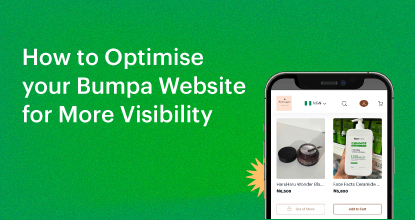
How to Optimise your Bumpa Website for more Visibility on Google in 2026!

Entrepreneurship
How To Start A Bag & Accessories Business In Nigeria In 2026

Tips
When to Upgrade Your Bumpa Plan And How to Know You're Ready

Entrepreneurship
10 Signs Your Business Needs Better Structure and Organization In 2026

Entrepreneurship
Bumpa vs WooCommerce: Is "Free and Powerful" Actually Free for Nigerian and Kenyan Businesses?

Entrepreneurship
Bumpa vs Shopify: Which Platform Actually Works Best For African Businesses?

Features
Is the Bumpa App Free? (2026 Update: What’s Free, What’s Paid & What You Get)

Entrepreneurship
How to Use Social Media to Drive Sales to Your Bumpa Store In 2026

Entrepreneurship
25 Small Business Ideas in Kenya with Low Capital (2026 Guide)
Features
Every Physical Store You Add on your Bumpa Account Now Has Its Own Terminal Account. Here's Why It Matters

Features
Grow Your Business Faster with Loans: Say Hello to Bumpa Capital!

Features
How to Stop Staff Theft in Your DMs and Your Physical Store Using Bumpa
Tips
Business Name Ideas - How to Generate One + 42 Examples

Entrepreneurship
Bumpa vs Wix: A Guide for Nigerian Business Owners

Entrepreneurship
Bumpa vs Paystack Storefront: Which Is Right for Your Business?

Entrepreneurship
Bumpa vs Flutterwave Store: What Nigerian Sellers Actually Need to Know
Entrepreneurship
7 Marketing Tools You Can Use on Bumpa To 5x Sales. (Free & Paid 2026)

Spotlight
From a Mom's Shop Floor to 10K Orders: How Harjoke Fabrics Automated Sales with Bumpa
Features
Bumpa Wallet Is Here: A Faster Way to Get Paid Instantly, Grow Your Money & Stay in Control
Spotlight
For our One of One, Teejay…
Entrepreneurship
8 Best Paystack Storefront Alternatives Nigeria (2026)

Sales
How to Start an Online Business in Kenya (2026 Complete Guide)

Features
Bumpa POS: A Simple Point of Sale System for Businesses in Nigeria

Entrepreneurship
How Bumpa Helps Business Owners Adapt To Nigeria’s New Tax Laws in 2026

Sales
5 Reasons Why Your Business Isn't Making Money (And How To Fix It)
Features
Selling Internationally: Start Collecting Foreign Payments with Bumpa’s Multi-currency Feature!

Features
How to Get Started on Bumpa: An Onboarding Guide.
Tips
10 Small Business Ideas you can start with 20,000 in Nigeria in 2026
Tips
How to Collect Customer Reviews and Boost Sales With Them In 2026

Tips
How to File CAC Annual Returns Online in 2026 as a Business Owner

Entrepreneurship
Happening Live: 30 Days of Bumpa with Kelvin! (Plus 3M Up for Grabs)!
Features
What’s New This Month for Your Business (November 2025)

Entrepreneurship
Share Your Story, Win ₦500,000: Bumpa Business Story 2025
Features
Bumpa Product Updates: What’s New This Month for Your Business (October 2025)
Features
Your Store, Your Way: Introducing Bumpa Website Extensions
Tips
Black Friday Coupon Code Ideas (2025): 27 Proven Promos + How to Name, Cap, and Track Them

Communities
"We Don't Do Impossible" - Celebrating CX Week at Bumpa
Tips
How to Create Professional Invoices for Small Businesses with an Online Invoice Generator
Tips
How to Create & Start an Online Store in Nigeria in 2024
Features
How to Use the Bumpa App: The Ultimate Guide For Small Business Management
Features
Recover More Sales With Bumpa’s New Automated Abandoned Order Reminders
Tips
Black Friday 2025: The Business Guide to Deals That Triple Your Sales
Spotlight
Ronbee Signature: The Entrepreneur who Ditched the Idea of Being A Professor to Become A Jewelry & Perfume Connoisseur.
Spotlight
How Melira Fits Started From A One-Bed Apartment to Doing Up To 15 Million in Revenue.
Features
Get Amazon-Level Delivery for your Business with Bumpa’s New Shipping Automation

Tips
How Businesses (Small and Big) Are Making Big Money with AI in 2025! (Here's How)

Tips
How to Make Money on the Internet in 2025 (12 Easy E-commerce Hustles That Actually Pay)

Tips
These 7 Business Finance Mistakes May Cost You Millions !
Tips
6 Bumpa Websites Designed With New Themes to Inspire Your Online Store
Features
The Ultimate Guide to Managing Your Multiple Stores for Your Business with Bumpa
Features
How to Set Up Google Analytics for Your Bumpa Website
Tips
These 5 Urgent Fixes Will Save Your Dying Online Store!
Entrepreneurship